Most sellers hope your package arrives safely.
I’ve built a system where it doesn’t matter if it doesn’t.
In this video: how I pack every Helios 44-2 that leaves my table, what I’ve put in place so you’re fully covered if anything goes wrong, and something about running a one-man lens business that most sellers would never admit.
Every lens is made to order. Built specifically for you.
transcript
If you’ve ever ordered something online and opened the box to find it damaged, you already know what comes next. You reach out to the seller, you wait for a response, you go through the whole dispute process. And the whole time, you’re the one carrying the stress of something that wasn’t even your fault.
I can’t guarantee your lens survives the journey. No seller can.
By the end of this video, that hesitation you’re feeling right now, about buying a lens from someone you’ve never met, shipping from a country you’ve never been to, that’s going to be gone. Because you’ll know exactly what you’re getting into. And exactly who’s got your back if anything goes wrong.
So here’s what I’m going to walk you through. How I pack every lens that leaves my table — the materials, the process, all of it. Then what I’ve put in place so that if anything goes wrong between my table and your door, you’re not the one dealing with it. And then I’ll tell you something about running a one-man lens business that most sellers would never admit, and why it actually works in your favour.
There’s this moment that I think about every time I ship a lens. Not because it went well but because it’s the opposite. And everything I do when I pack a lens exists because of it.
I was browsing ebay as usual until I spotted a good deal. Three vintage soviet lenses still attached to their Zenit camera. I checked the listing, satisfied with the item condition, and then pressed the buy button. Just like every other purchase.
Three weeks later, the package arrived. I remember picking it up and already feeling something was not quite right. The same feeling when you turn the steering wheel on a different car, when you’ve driven your own for years.
The lenses weren’t individually wrapped. In fact, it was just thrown together in this little box, held by a single layer of air cushion.
I raised the issue with the seller. After a few exchanges, I got a partial refund. But I still ended up with dented lenses, lenses that didn’t have to be dented in the first place. I’ve been that buyer. So I know exactly what that feels like. And that’s exactly why I refuse to be that seller.
The courier didn’t put those dents on the lenses. That damage was decided the moment that box was packed.
Most people think packing a lens is the easy part. I didn’t want anyone opening a package from me and feeling what I felt that day. So I started thinking differently about packing entirely. Amazon’s been around for thirty years. You’d think by now every seller has figured out how to pack something properly. I thought so too, until I opened that box.
Here’s what nobody thinks about when shipping something irreplaceable across the world. The moment I hand that box to a courier, it’s literally out of my hands. It gets tossed onto a conveyor belt, stacked under heavier boxes, sorted by machines that don’t know there’s a fifty year old lens inside. Nobody in the logistics chain knows or cares what’s inside. That’s just the reality of how things move across the world. That’s not an accusation. That’s just the reality.
So the question isn’t whether something can go wrong. It can. And It will, eventually. The question is what can I do about it before that box leaves my hands.
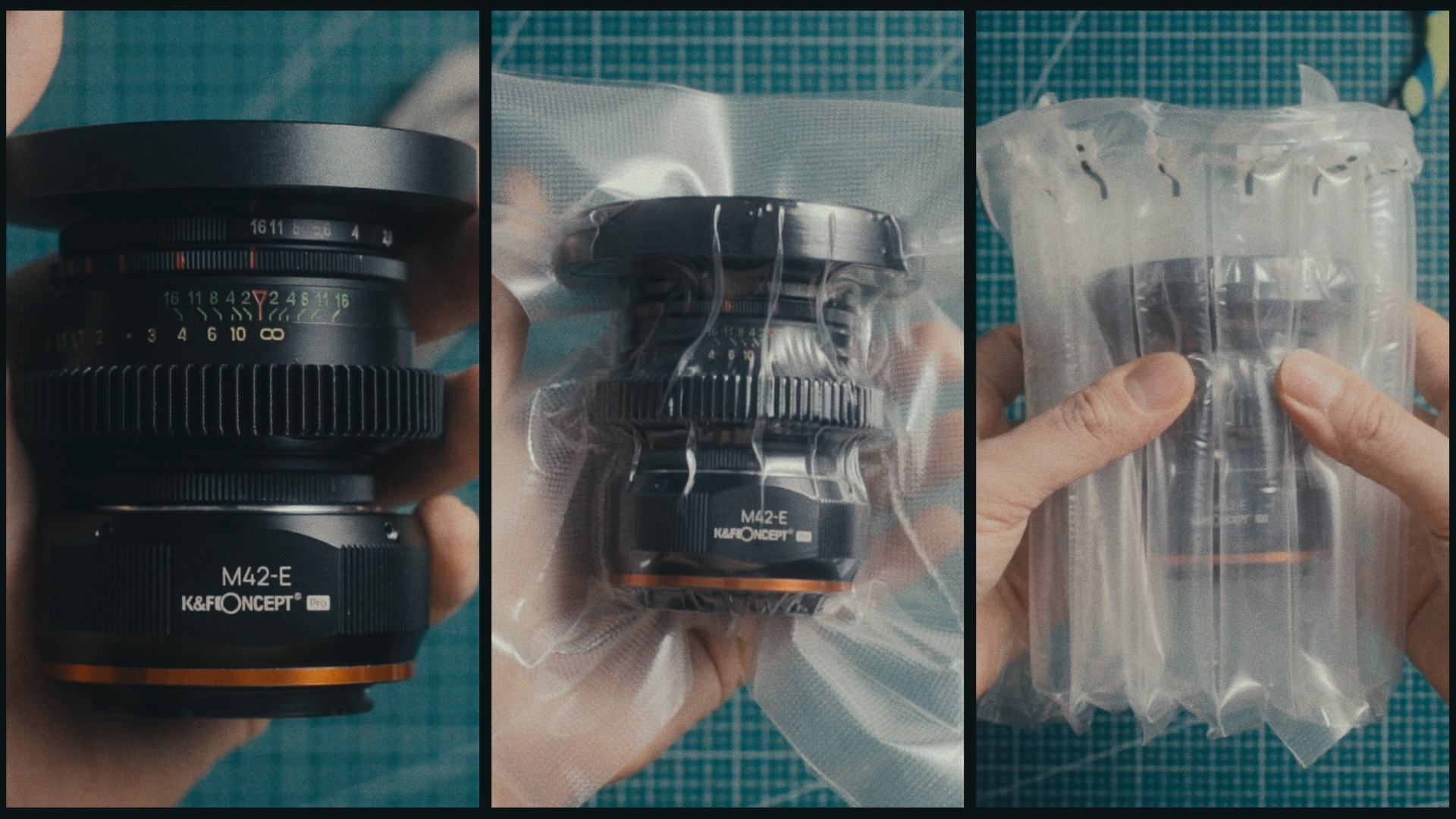
So this is what I do. First, the lens goes into a vacuum seal. Then it goes into an air column packaging. The kind engineered for wine bottles. Not because a Helios 44-2 is a bottle of wine, but because after hours on my table and weeks of waiting on yours, it deserves to arrive exactly the way it left, ready to shoot.
If you’ve ordered multiple lenses, each one gets its own box, then everything goes into a single outer box. It’s box inside a box. It’s more work, But I’d rather do it right than explain to you why your lens arrived damaged.
At the end of the day, this is a fifty year old lens. It’s already survived half a century. The least I can do is make sure it arrives safely for your next shoot. And now you’ve seen exactly how I do that.
But here’s the question I haven’t answered yet. What if something still goes wrong? What if the packaging holds, the box survives, and somehow, the lens still arrives damaged?
I’m a solo operator. And if you’re one too, you’d know how we are always poking the calculator when it comes to the purchase. Every lens I ship represents real money — mine and yours. And I’ll be honest, in the name of “competitive pricing” and “budget friendly”, there are shortcuts I could take here. I could send your lens to the cheapest courier, hope for the best, deal with the fallout if it comes. But when things do go wrong, it will cost both sides more than it ever needed to.
So I made a decision early on. Every lens I ship internationally is insured at full value, no exceptions.
Here’s what that actually means for you. If your lens arrives damaged, you send me picture evidence. That’s it. I submit the claim, and the next lens in queue ships out to you. There’s no dispute to file, nothing to send back, and you’re not waiting on a platform to decide who’s right. I’ll handle it.
Look, I’ve been on your side of this. I’ve opened a box and already knew something was wrong before I even saw the damage. A partial refund didn’t fix how that felt. I’m not putting you through that because you’re not a number in my spreadsheet. I just want your lens to arrive ready to shoot, so you can go make something.
When you’re ready, the link in the description takes you to the order page. Every lens is made to order, built specifically for you. The rest is mine to handle.
Leave a Reply