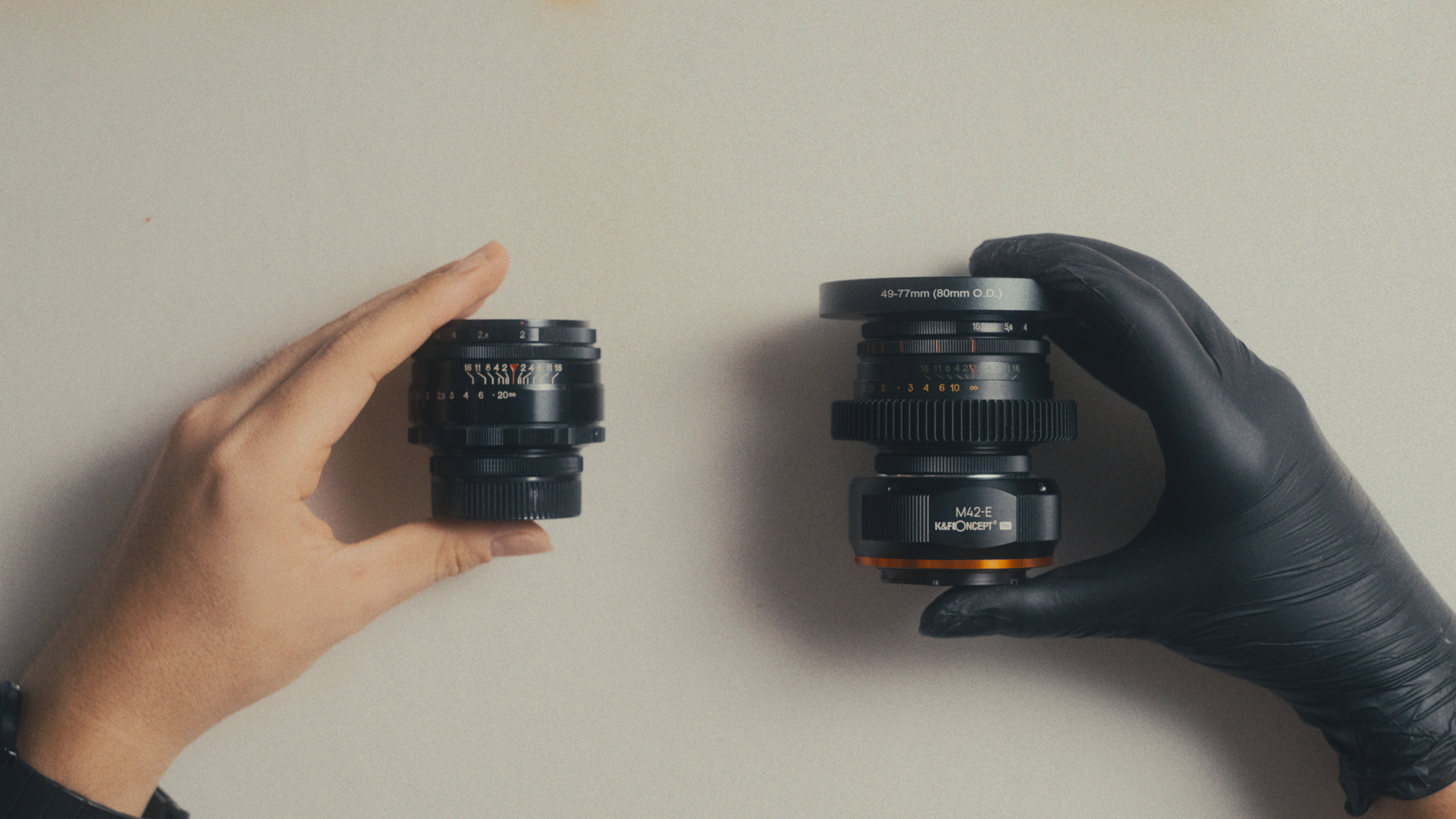
You can buy a Helios 44-2 on eBay for $80.
You can also spend $4,500 on a fully rehoused cinema version of the same lens.
Most working filmmakers land somewhere in the middle — and that’s exactly what this video is about.
If you’re a working filmmaker considering a cine modded Helios 44-2 for paid work, this video covers everything you need to make an informed decision:
- What you’re actually getting from an $80 eBay unit — and why “CLA-ed” listings may not mean what you think
- What a full cinema rehouse delivers, who it’s built for, and why the lead time alone rules it out for most productions
- What a proper service and cinemod actually involves — full helicoid strip and relube, aperture ring grease replacement, focus shift elimination, follow focus gear ring installation, and a custom aperture marking modification that no stock Helios 44-2 has had in 66 years of production
- Real footage shot on a fully serviced and cinemodded unit — available light, handheld street, outdoor portrait, and slow-mo fashion
By the end of this video you’ll have seen exactly what goes into a properly serviced and cinemodded Helios 44-2 — not claimed, not described, actually shown.
Ready to order?
Every unit is built to order — pre-order only, 30 to 45 day turnaround, 1 year warranty.
Compatible with Canon EF, Sony E, Canon RF, Leica L, Nikon Z and Fuji X mount systems.
Order here → https://www.dwaynefoong.com/shop
transcript
So you found a Helios 44-2 on eBay for $80.
Maybe you’re staring at the listing right now trying to decide if it’s worth it.
The footage you’ve seen online looks incredible.
The price seems almost too good.
But you’re not buying this for fun.
You’re putting this on a job, and a $80 gamble that fails on set isn’t a $80 problem anymore.
That’s the right instinct.
Now here’s where it gets interesting.
At the other end of the market, there are fully rehoused cinema versions of this same lens going for $4,500.
It uses the same optical formula but it’s a completely different product.
So you’ve got $80 on one end. $4,500 on the other.
And most working filmmakers I talk to are stuck somewhere in the middle.
They need something professional enough to put on a paid job, but they’re not running a lens truck.
I’ve been servicing and cinemodding Helios 44-2s for filmmakers for a while now, and in this video I’m going to tell you exactly what your money actually buys at each price point, and what I’d genuinely recommend depending on where you’re at.
Let’s get into it.
WHY FILMMAKERS WANT THIS LENS
You’ve already seen what this lens can do.
That’s probably why you’re here.
The way the lens flares when you backlight it, the way it render skin tones that is so flattering to the subject, that organic look that feels like cinema.
You’ve watched the sample footage and you get it.
I don’t need to sell you on the look.
You’re already sold.
So let me give you the context that most videos skip.
When I first started selling Helios 44-2s, most of my buyers were exactly who you’d expect — hobbyists, photographers, weekend shooters experimenting with vintage lens.
That’s fine.
That’s a real market.
Then one day a production studio owner bought a set of vintage Soviet lenses from me.
A full set, Including the Helios 44-2.
I didn’t hear from him directly, but his assistant did told me later,
he loved the flares
That was it.
One sentence.
But it told me everything I needed to know, this wasn’t someone shooting for fun.
This was a working professional who chose this lens deliberately, for a paid job, because of a specific optical quality he needed.
And it didn’t stop there.
More filmmakers started finding me — people shooting short films, drama series, commercial work. And they weren’t buying just one lens to try.
They were buying sets.
The Helios 44-2, the Mir-1b, the Jupiter-9.
These were deliberate creative decisions, not weekend experiments.
That’s when I understood, the $80 eBay listing you’re looking at right now isn’t just a cheap weekend toy.
It’s the same optical formula that working professionals are actively choosing for paid work.
The glass is the same.
What’s different is everything around it.
And that’s exactly what this video is about.
THE $80 OPTION
Let’s talk about the $80 unit.
And I want to be fair here, because some of you genuinely should buy it.
If you’re experimenting, if you’re a photographer who wants to play with the look on weekends, if you just want to see what the fuss is about.
The $80 unit is fine.
Buy it.
But if you’re putting this on a paid job, you need to understand what you’re actually buying.
On eBay, you’ve got a few options.
The cheapest units are around $80.
They look fine.
You’re scrolling through the photos and nothing jumps out as wrong.
There are no promises about servicing, and no claims about condition beyond ‘works great.’
You know what you’re getting into.
It’s a gamble and the listing doesn’t pretend otherwise.
But then there are units listed as CLA-ed.
Cleaned, lubricated, adjusted.
These go for $100, sometimes more.
The seller is charging a premium because they’re implying professional work was done.
And that’s where it gets interesting.
Let me show you what I found when I opened one.
That’s oil on the aperture blades.
It gets there because the grease on the aperture ring degrades over time, liquifies, and migrates into the aperture mechanism.
That’s a material aging problem, after all, we are talking about a vintage lens that’s over 50 years old.
It happens to every neglected unit eventually.
In all the lenses I’ve opened, I have never once seen anyone replace the aperture ring grease.
Not even on lenses marked as CLA-ed.
That’s not one bad seller.
That’s a pattern.
This is a separate mechanism.
It controls your focus throw.
A proper CLA means fully stripping the old grease out before applying fresh lubricant.
What I find on almost every unit is new grease sitting on top of old grease.
The old grease was never removed.
Just topped up and called done.
That’s two separate mechanisms, both neglected.
On a lens someone sold as professionally serviced.
The word CLA-ed on an eBay listing doesn’t mean what you think it means.
It means someone wiped down the barrel, maybe ran a cloth over the elements, topped up the helicoid without stripping it, left the aperture ring grease untouched, and called it done.
The work that actually matters, the work that determines how this lens behaves on a job, either wasn’t done, or wasn’t done properly.
And you’d never know because the listing looked fine, and the photos looked fine. The seller used the right language.
They even charged you more for the privilege.
You paid a premium for a label.
The label lied.
Now, does oily aperture blades or a poorly serviced helicoid make the lens completely unusable?
Not always.
You might get lucky.
The unit that shows up might be functional enough to shoot with.
But here’s the thing about luck on a paid job.
If it runs out, the $80 you saved isn’t the number that matters anymore.
The reshoot is.
So who should buy the $80 unit?
Hobbyists.
Photographers.
Anyone shooting for themselves where the stakes are low and the gamble is fine.
The question isn’t whether the $80 unit is bad.
The question is, what does good actually look like?
Because most people have never seen it.
THE $4500 OPTION
Now, at the other end of the market, there’s IronGlass.
IronGlass takes the same optical formula and rebuilds it from the ground up into a proper cinema lens .
New housing, T-stops, consistent diameter, permanent mount.
The kind of lens you hand to a 1st AC without a second thought.
It’s a serious product.
I have a lot of respect for what they do.
This is what a full cinema rehouse looks like.
And the price reflects it.
You’re looking at $4,500.
For a lot of working filmmakers watching this, that number alone ends the conversation.
And that’s fine — it’s supposed to.
This lens is built for productions with a lens budget, a camera truck, and a dedicated camera department.
That’s the use case it was designed for.
But there’s a second problem that even the filmmakers who could stretch to the budget often don’t think about.
Lead time.
A full IronGlass rehouse takes 12 months.
Sometimes longer.
You’re not ordering this tomorrow because you have a job in three weeks.
You’re planning around it well in advance, if you can plan around it at all.
Most of the working filmmakers I deal with don’t have that luxury.
They have a project coming up.
They need a lens that’s ready.
And they need it to work.
So, $4,500 and a year away.
For the right production, that’s a completely reasonable trade.
For most of the people watching this video, it isn’t.
Which is exactly the gap I want to talk about next.
WHAT GOOD ACTUALLY LOOKS LIKE
Earlier I asked what good actually looks like.
Here’s the honest answer, it’s not one thing.
It’s a series of problems that reveal themselves the deeper you go into this lens.
Problems that exist because nobody at the factory in 1958 imagined a filmmaker in 2026 pulling focus for a paying client.
This lens was built to take photographs.
Your job is to make films.
Let me show you everything that stands between those two things, and how each one gets solved.
Every single unit gets fully disassembled.
I’m not wiping it down and calling it done, I’m not topping up the grease.
It comes completely apart because you cannot see what you’re dealing with until you open it.
This is the mechanism that controls your focus throw.
On most units that come through my hands, the grease has been topped up.
New lubricant on top of old lubricant that was never removed.
It looks serviced, but It isn’t.
Old grease and new grease don’t mix well.
Over time the combination thickens unevenly, creating stiff spots and inconsistent resistance through the focus range.
On a job, that’s a focus pull you can’t trust.
The helicoid gets fully stripped before fresh lubricant goes in.
My test for the right resistance is simple.
Pinky finger only.
If my pinky doesn’t have enough torque to move the focus ring smoothly through its full range, it’s too stiff for professional use.
It sounds simple.
But it’s the most trusthworthy resistance test I know, because on a run-and-gun job, you don’t always get both hands on the lens.
There’s a second problem with the helicoid that almost nobody talks about — focus shift.
When you pull focus in one direction and then reverse, there’s a moment of mechanical play where the image shifts or jitters slightly before the focus catches up.
On a photo lens used for stills, it doesn’t matter.
On a moving image, it’s visible.
On a paid job, it’s unprofessional.
Rehoused cinema lenses guarantee no focus shift because they’re built from the ground up for film.
A stock Helios 44-2 was never tested for it.
So as part of the helicoid service,
I check and minimise focus shift on every unit, because it’s the kind of problem that only shows up when you’re already rolling.
The aperture ring is separate from the helicoid, and it’s a different problem entirely.
The grease here is almost always the original factory lubricant.
50 years old, and never replaced.
Over time it degrades, liquifies, and migrates into the aperture mechanism and onto the blades themselves.
That’s the oily aperture blades I showed you earlier.
In all the units I’ve opened, I have never once seen this grease replaced.
Not even on lenses marked as CLA-ed.
It is the most consistently neglected part of this lens.
On every unit I work on, that grease comes out and goes in fresh.
It’s not complicated, it just requires actually doing it.
And once it’s done, you stop thinking about it.
Which is exactly what you want from a lens on a paid job.
The optical elements get cleaned individually.
I’m not putting anything back together until the glass is clean, without haze and without residue.
What goes back in is clean glass.
The Helios 44-2 is a stills lens.
It was never designed with follow focus ring.
For a photographer, that’s irrelevant.
For a filmmaker on a rig, it’s the first thing that makes this lens unusable professionally.
The gear ring I install is 3D printed in PETG, and before you raise an eyebrow at that, let me tell you how I got here.
I started with an off-the-shelf seamless follow focus gear from a reputable brand.
The kind you’d find recommended in every filmmaker forum.
I used it but I wasn’t satisfied.
So I worked with another filmmaker who knows 3D printing.
We went through a few revisions until we landed on something that actually worked.
I’ve used it on my own shoots ever since.
It hasn’t failed once.
And in all the units I’ve sold to working filmmakers, I’ve never had a single complaint.
The follow focus ring I install is the industry standard 0.8 pitch.
Attach your follow focus on and you’re done.
There is nothing to figure out on set.
This one is different from everything before it.
The focusing helicoid, the aperture ring grease, follow focus gear, those are problems that can be fixed with proper servicing.
This one is a design problem that has existed in every Helios 44-2 ever made.
Most people don’t know this, but the Helios 44-2 already has a declicked aperture ring built into the factory design.
There are two aperture rings.
This clicky ring sets your minimum aperture limit, this clickless ring physically opens and closes the blades during a shot.
Which sounds perfect.
Until you look at the markings.
The clickless ring has no accurate aperture markings.
There is minimum and maximum only.
Everything in between is unmarked.
On a job, that means you’re guessing your aperture mid-shot.
You can’t tell your gaffer exactly what you’re at.
You can’t repeat an exposure from one setup to the next.
You’re operating a professional tool with no reliable reference.
This problem has existed in every Helios 44-2 ever made.
In 66 years of production, nobody fixed it.
So I did.
I engineered my own aperture markings for the clickless ring.
You can see exactly where you are in the aperture range during a shot — f/2, f/2.8, f/4, all the way through.
It’s accurate, repeatable, and specific to this lens.
Something the stock lens never had in 66 years of production.
It’s a small modification.
But it’s the one that means you actually know what you’re doing with this lens on a job rather than guessing it.
One more thing — and this one only reveals itself when you’re actually on a job with a filter system.
The clicky ring sits very close to a 77mm step-up ring on this lens.
When the aperture ring grease hasn’t been replaced — which is almost always — the clicky ring gets stiff.
Stiff enough that changing your minimum aperture setting with a step-up ring in place becomes a real problem.
There is not enough clearance to get a proper grip.
As part of the aperture ring service, I tune the clicky ring resistance — soft enough to change settings easily in the field, firm enough to hold its position during a shot.
It’s a small adjustment, the kind that only matters when you’re on set and it would have cost you a take.
The Helios 44-2 has a M42 screw mount — which means you use an adapter to connect it to your camera.
And the adapter matters more than most people think.
A cheap one adds its own play on top of whatever your camera body already has.
The ones I include are chosen specifically because they add nothing.
It has solid construction and achieve infinity focus reliably.
Someone’s going to ask about mount play, and that’s a fair question.
Any bayonet mount on a camera body has some inherent play by design.
That’s just how they’re built.
What I can control is what the adapter contributes on top of that. If you want truly zero play, a locking mount on the camera side is the answer — but for the overwhelming majority of handheld and rig work, what’s included will serve you well.
I support Canon EF, Sony E, Canon RF, Leica L, Nikon Z, Fuji X — so whatever system you’re shooting on, you’re covered.
The last thing I do before anything ships is put it on a camera myself.
I shoot a test chart to confirm the glass is clean, run it through a follow focus to check for any focus shift, and verify infinity focus on a distant subject.
If anything is off — it doesn’t go out.
That’s six problems fixed.
One of them hadn’t been touched in 66 years.
What comes out of that process is a working filmmaker’s lens.
Not a vintage photographer’s lens where you have no idea what you’re getting until it shows up at your door — and even then you’re not sure if it’ll hold up on a job it was never designed for.
This is a lens that was actually prepared for professional film use — without the $4,500 price tag or the year-long wait.
You’ve seen every step.
You don’t have to take my word for any of it.
IS IT WORTH IT?
So — is a cine modded Helios 44-2 worth it?
If you’re a hobbyist, or you’re just curious about the look, honestly, buy the $80 eBay unit.
Experiment with it and see if it’s for you.
That’s a completely valid way to start.
But if you’re a working filmmaker — if you have jobs on the calendar, clients who are counting on you, and you need a lens that behaves like a professional tool — then yes.
It’s worth it.
Not because I’m selling one.
Because you’ve just watched me show you exactly what the difference is.
Every unit is a pre-order.
Which means each lens goes through everything you’ve just watched, before it ships to you.
Turnaround is typically 30 to 45 days, and every unit comes with a one year warranty.
Everything you need to make the decision is in this video and on the store page.
I’ve been doing this long enough to know that the filmmakers who buy from me aren’t looking for the cheapest option.
They’re looking for the right one.
If that’s you, head over to my store page.
I’ll take it from there.
Leave a Reply