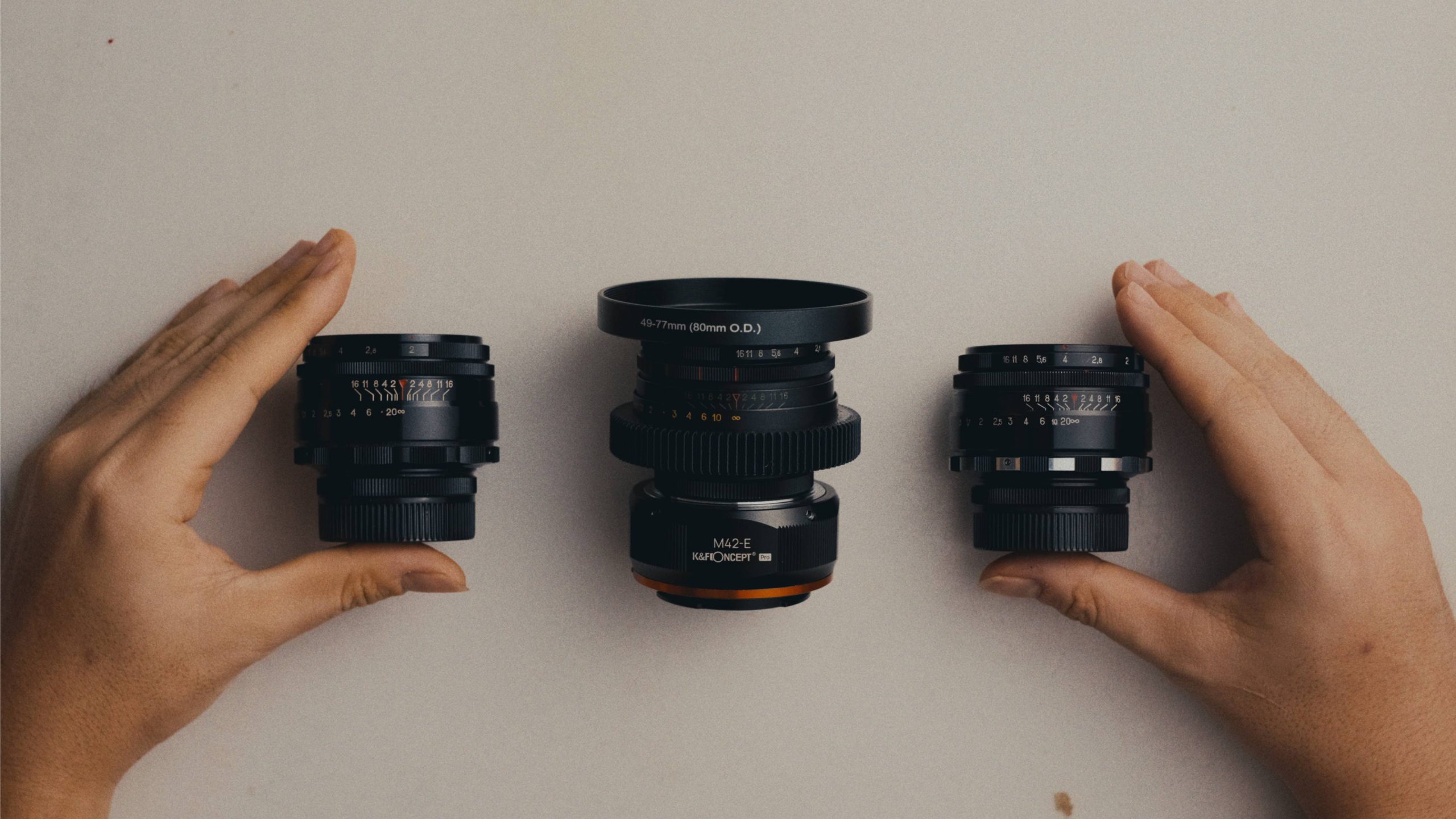
There are hundreds of videos about which Helios 44-2 factory is better.
Which production year to hunt for.
Which version to buy.
This isn’t one of them.
I’m putting three copies of the Helios 44-2 side by side — a stock eBay copy, a fully serviced copy, and my cinemod — because before you put any of these on a professional rig, in front of a client, you should know exactly what you’re getting.
This isn’t a spec comparison. It’s about what happens when the director calls action and the lens either holds up — or it doesn’t.
If you shoot on a rig, work with an AC, and take your craft seriously enough to make sure every piece of your kit performs when it matters — this video is for you.
Order the Helios 44-2 Cinemod here.
transcript
You know that silence.
The take just ended.
Everyone in the room is looking at the monitor.
The client.
The agency people.
And the director, the one who hired you, the one who told the client you were the right person for this job, is looking at the monitor.
And nobody says anything.
But everybody saw it.
And then the director turns.
Not to the monitor.
Not to the client.
To you.
And the worst part, it was avoidable.
There are so many videos out there about which Helios 44-2 factory made the best copies.
Which production year to look for.
Or which version you should or shouldn’t buy.
This isn’t one of those videos.
Because none of that matters.
Not if the lens you’re putting on your rig was never built for that room.
I have three copies of this lens in front of me.
And what separates them isn’t what most people think.
Let me show you what I mean.
When I was starting out, there was a seller I really looked up to.
He had a YouTube channel dedicated to vintage Soviet lenses, a strong reputation, and honestly, I trusted his work completely.
I actually learned how to relubricate my first Helios lens from his video.
Then one day a client sent me a Jupiter-9 to remove an anamorphic mod from it.
It was bought from that same seller.
When it arrived, I remember holding it and thinking, this is a masterpiece.
A vintage Soviet lens that went through the hands of someone I genuinely respected.
The master technician himself.
I was excited to open it up.
Not just to do the job, but to see how he did it.
It’s like examining an art piece in an exhibition, up close.
And then I opened it.
The original Soviet grease in the aperture ring was never replaced.
And when I shot a test chart, it was decentered.
And look, this wasn’t some $30 eBay flip.
This was a lens sold by someone people in this community genuinely trusted.
Someone with a following.
Someone whose videos were teaching other people how to work on these lenses.
And the buyer had absolutely no idea.
How would they?
You can’t see inside a lens from a listing photo.
You’re an artist, not a lens technician.
You just trust the name.
That buyer trusted the name.
And got a shortcut.
And the only way they found out what they actually bought, was when the shot didn’t work. In that room. In front of everyone.
That was the moment I really understood something about this space.
A reputation without standards isn’t credibility.
It’s just cover.
I knew what that cost,
because I came from a world where there was no cover to hide behind.
I spent years shooting fashion and commercial work, back when Instagram was still just food photos and word of mouth was the only thing that mattered.
There was no algorithm to save you.
No viral content to fall back on.
If you delivered a bad job — that was it.
The phone stopped ringing.
So we were careful.
We showed up with equipment redundancies and multiple backups.
We shot tethered to a laptop.
We checked every image at 100%.
We confirmed with the client on the spot before we packed up and left.
Not because someone told us to.
Because we couldn’t afford not to.
That’s the standard I brought to the bench.
So my name goes on every lens that ships.
Because once that trust is gone — it’s gone.
If you’re a DP or camera operator, you already know what a Helios 44-2 can do.
You’ve seen the footage.
You know the character.
You’re not here because you need convincing on the optics.
But at some point you started digging.
And the more you dug, the more confusing it got.
Which factory is better. Which production year. Which serial number range.
Everyone has an opinion and none of them agree.
And then you start looking at the actual lenses.
And you realise there’s no way to tell from the outside which one is going to hold up and which one isn’t.
So picture this.
You’re on a shoot.
You’ve got an AC next to you.
Client is on set.
Agency people are watching the monitor.
You’ve prepped everything.
The rig is dialled in.
The shot list is tight.
And you’ve got a Helios on the front of the camera because you know what it does to skin tones, to that background separation, to the overall feel of the image.
And then your AC goes for the first focus pull of the day.
The director is watching the monitor.
The client is watching the monitor.
The agency people are watching the monitor.
Nobody says anything.
But everybody saw it.
The director calls cut.
And now you’re the one explaining why.
And look — that’s not on your AC.
He did everything right.
He pulled exactly where he mapped it.
The lens just wasn’t consistent enough to hold up.
Nobody in that room cares that it was an $80 eBay copy.
They just know the shot didn’t work.
And you’re the one standing there.
That’s the moment I want you to think about.
Because that moment is a choice you make before the shoot.
Not during it.
And honestly, most of us have already decided we’re not willing to be in that position.
We’re not willing to hand an AC a lens and secretly crossing our fingers
We’re not willing to put a lottery lens on a rig we spent real money building.
We’re not willing to stand in front of a client and explain why the shot didn’t work, when the answer is that we cut a corner on the lens.
That refusal, that’s what separates the people who take their work seriously from everyone else.
People like us don’t settle for a lens we can’t rely on.
People like us buy lens that works like it belongs on that rig.
Every single time.
So let me show you what the difference actually looks like in your hands.
Three copies.
Same lens.
Same optics.
But only one of them was built with that moment in mind, the one where the director calls action and everything has to work.
This is the stock eBay copy.
Untouched.
Unverified.
The person who sold this had one goal, to get it off their hands.
What it does on your rig, on your set, in front of your client, that was never part of the equation.
That inconsistency, that’s what your AC is dealing with when he’s trying to pull focus on a take.
And there’s no follow focus gear.
So on a rig — you already know what that means.
But here’s the part most people don’t think about.
This lens is over 50 years old.
And it’s never been properly cleaned inside.
You can’t see it from the outside.
It doesn’t show up in a listing photo.
But mount it on a camera…
This is what happens when the person who sold it never thought about you.
Never thought about your AC.
Never thought about your client watching the monitor.
Their job ended the moment you paid.
Yours was just getting started.
This is my fully serviced copy.
Not a copy with a serviced label to get a better price. Mine.
You already know what that means.
Yeah.
That’s what it’s supposed to feel like.
That’s the character you chose this lens for.
Right there.
This is a lens you can rely on.
A lens that performs the same way every single time you pick it up.
And I’ll be straight with you, the image this produces is identical to the cinemod.
But on a rig, it’s still a still photography lens.
And that gap is real.
And this is the cinemod.
It’s the same foundation underneath as the serviced copy.
That’s not a footnote, that’s everything.
Because none of what’s on top matters if the groundwork wasn’t done right.
By someone who actually understands what production work demands.
So let me show you what that foundation makes possible.
That moment, the one where the camera started rolling and nobody says anything and the director calls cut, that moment doesn’t happen.
Put it on a rig and it just works.
Because I’ve been on those sets.
I know what that moment feels like.
And I built this so that moment never happens because of the lens.
All three units have the same design and same glass.
But what you get out of it depends entirely on what was done to it before it reached you.
And that decision, what was done to it, by whom, and why, that was made long before you found this video.
The only question left is whether you’re going to make the same kind of decision going forward.
Something is changing in how serious filmmakers think about vintage lens.
They’re tired of the lottery.
Tired of getting on set and realising the lens isn’t consistent enough to rely on.
Tired of standing in front of a client and trying to explain why the footage doesn’t look the way it was supposed to.
They’ve decided that vintage character and professional reliability are not a compromise.
And they’ve stopped cutting corners on the lens.
These are filmmakers who shoot on a rig.
Who work with an AC.
Who take their craft seriously enough to make sure every single piece of their kit holds up when it matters.
They’re not waiting for the perfect moment to upgrade.
They’ve already decided.
Because the work they’re making right now demands it.
If that’s not you yet, that’s okay.
Go find a clean stock copy. Enjoy the character. Come back when you’re ready.
But if you’ve already decided, if you watched this and realised that cheap lens on a professional rig was never actually saving you anything, then you already know what comes next.
It’s available to order here.
And my name is on it.
Leave a Reply