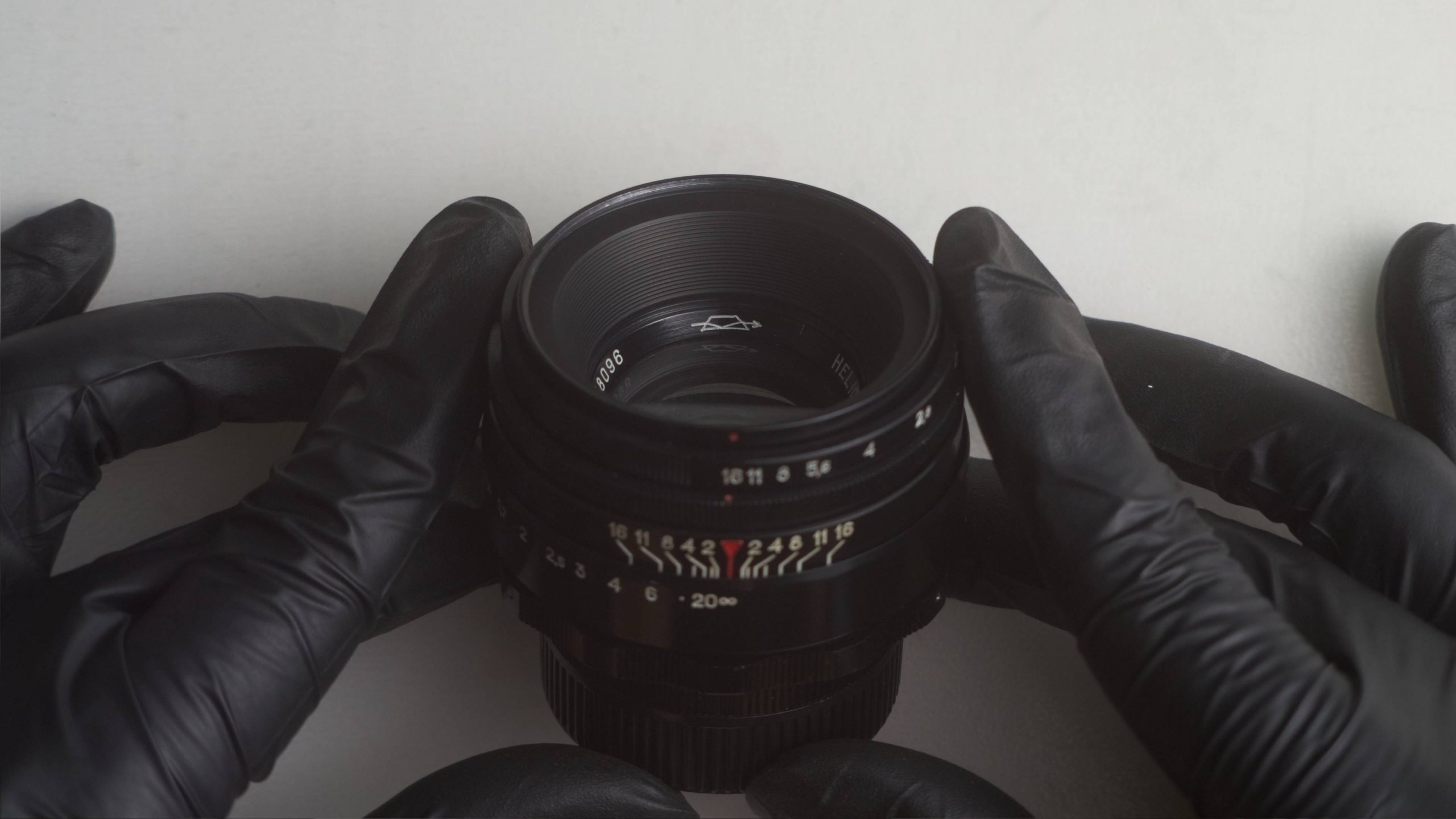
The internet says KMZ is the best Helios 44-2 you can buy. And if you find one with a serial ’00’? That’s supposedly reserved for communist party leaders. The highest quality glass the factory ever made.
So I got one.
And instead of taking that at face value, I tested it the way most Helios 44-2 reviews never do.
Sharpness and contrast, measured with luma values, not eyeballed. Backlight and flare control, with both lenses on the same baseline. Focus ring smoothness, and what’s actually producing it when you disassemble the lens. Aperture blades, and what the condition of the blades tells you about the rest of the lens.
By the end of this video, you’ll know whether the KMZ serial ’00’ reputation holds up.
transcript
This is a KMZ Helios 44-2 with a serial ’00’.
The internet says this is the best one you can buy.
They say it’s reserved for communist party leaders, built to a higher standard than anything else that came out of the factory.
Forum posts say it.
Blogs say it.
YouTube comments say it.
eBay sellers charge a premium for it.
And camera-wiki.org has it documented.
It if’s on a reference website, then it must be true.
For filmmakers and video creators looking for a Helios 44-2 to use on a job, this is the one collectors and youtube comments will tell you to get.
So I got one.
And I’m going to open it up.
By the end of this video, you’ll know exactly if that reputation is true.
I’m going to test sharpness and contrast, backlight and flares, the focus mechanism, and the aperture blades.
And I’m doing it in a way you won’t find in any other Helios 44-2 reviews.
Better image quality, to me, comes down to one thing: does the image separates the subject, or does it look flat and muddy.
Contrast, that’s what creates that separation.
So let’s start there.
This is lens A, and this is lens B.
One of these is the KMZ serial ’00’, the one the internet says was reserved for communist party leaders, built to a higher standard.
The other is a common Helios 44-2, made in the same era with no special markings.
Based on image quality alone, which one is the better lens?
Most reviews would stop here.
They would point to the better image, name the lens, and call it proven.
If A looks sharper, it must be the better lens.
If B looks flat, blame it on Soviet quality control, factory logo, or the year of production.
But here’s what those reviews aren’t telling you.
This milky layer is haze.
Grease inside the lens evaporates over time and this is where it ends up.
You’ve seen it on glass windows.
Most Helios 44-2 out there have this, and this high quality copy is no exception.
It is a common problem in all Helios 44-2, and I will explain the reason later.
So before I run any test, I clean every lens element individually.
Each unit gets fully disassembled.
It’s the only way I know the result I’m seeing is actually coming from the lens, not the result of evaporated grease.
This is the same lens before and after.
The contrast improved by 10%.
This is exactly the same lens shot with the same settings.
The only difference is we are testing the real clean glass.
This is how the same two lenses look after a proper clean.
Now we are looking at a fair test. If the serial ’00’ truly means better optical quality, it should be visible right here, right now.
The luma value at this center position reads 54 for lens A, and 49 for lens B, which tells us one lens has 1.96% better contrast than the other.
So. Does that match what you picked at the start?
But sharpness and contrast is only half the picture.
Backlight is where a lens really gets exposed.
I personally love shooting backlit.
It creates this beautiful rim light separating the subject, and who could say no to these flares?
There’s a quality to it that’s hard to replicate any other way.
But backlight is also where a lens shows its limits.
Modern lenses are coated specifically to handle backlight.
It minimise flares, control ghosting, and keep the shadows clean.
So if the serial ’00’ was truly built to a higher standard, reserved for communist party member, we should see that here.
Because better coating equals better backlight control.
That’s the logic.
I set up a simple test by placing a backlight just off frame, aimed at the back of the head with some spill hitting the lens directly.
I didn’t use any fill light in this test, I want the shadows as deep as possible so any difference between the two lenses is obvious.
And just like the previous test, both lenses are fully cleaned before we start.
This is lens A.
This is lens B.
A lens with superior coating would show cleaner shadows, less ghosting, and fewer artifacts.
If the ’00’ serial means what the internet says it means, one of these should stand out right now.
I’ll extract the luma value at the same point in both frames.
Lower value means deeper blacks, that’s what are are looking for.
Lens A reads X and Lens B reads X.
That’s a difference of X%.
Is that the result you expected?
So age and condition matter more than the serial number, at least when it comes to image quality.
But what about the mechanics?
Let’s find out.
When people talk about build quality in a lens, they usually mean the focus ring.
If it turns smoothly, it is well built.
If it is stiff, or the resistance is uneven, then it is lower quality.
That’s how most people think about it.
For me it’s simpler than that.
If I can’t pull focus smoothly, I’m going to miss the shot.
That’s what actually matters when shooting for client work.
So I have a test for this.
I call it the pinky test.
If I can turn the focus ring with my pinky finger, it pass the test.
If I can’t, then it’s too stiff.
This is the most promising result I’ve seen so far.
The focus ring is smooth all the way through.
I don’t notice any stiff spots.
So maybe this is where the serial ’00’ finally proves itself.
If it is better built with stricter quality control, it would make sense that it shows up here.
But I want to know what’s actually making it smooth even after half a decade.
Did a Soviet engineer come up with a secret sauce?
I’m going to find out.
This is what’s inside.
I can see two tone of colours.
The one in brown is the original Soviet grease, which is over fifty years old.
The one in grey is modern lithium grease, applied on top.
So someone serviced this lens at some point and didn’t remove the old grease. They just slapped a new layer of grease over it.
The ring feels smooth, but this isn’t good servicing.
This is a shortcut.
Every Helios 44-2 I’ve opened has one of two problems.
Either the factory applied too much grease to begin with, or a lens technician added fresh grease on top of old grease without removing what was already there.
This high quality copy, has both.
Grease breaks down and evaporate slowly onto the glass over time.
That milky layer we cleaned off in the first test, that’s this.
So you might ask, why does it matter if it works?
And that’s a fair question.
For me it comes down to this: I could leave the old grease in, apply a fresh layer on top, and hand you a lens with a smooth focus ring.
It would pass the pinky test.
But I’ve just showed you the consequence of taking a shortcut.
When I service a lens, the old grease comes out completely.
I apply a thin layer and spread evenly with a brush.
The problem with excessive grease is that it migrates, attracts dust and dirt, and evaporates onto the glass.
That’s the standard I hold it to.
Not because I charge more for it.
Because it’s the only way I know the lens will actually last.
Before I continue, I’ve had photographers reach out asking if they could by the same lens, serviced to the same standard shown in this video.
The answer is yes.
The two exact lenses in this video are available.
Lens “A”: https://www.dwaynefoong.com/7607230
Lens “B”: https://www.dwaynefoong.com/0058096
There’s one more thing I want to check.
And this one is easy to spot, even for someone without any experience.
Oily aperture blades.
I find this all the time in Helios 44-2 lenses, regardless of the factory logo.
The blades still open and close, the aperture still works, so most people dismiss it as a cosmetic issue that doesn’t affect image quality.
But oil on the aperture blades isn’t the problem.
It’s a symptom of a bigger problem most people never find out.
If oil has reached the aperture blades, then oil is present throughout the lens barrel.
And we already know where oil inside a lens barrel ends up.
So the question is, would a serial ’00’, built with stricter quality control, be in better condition than the rest?
Oil on the blades.
It’s visible and easy to confirm.
But I want to see what’s happening further inside.
There’s oil coating the inside of the barrel.
And here as well, the lens element.
It is the same staining we’ve been tracing this entire video, back to the same source.
This is degraded grease breaking down over decades, migrating and contaminating every around it.
The serial ’00’ didn’t beat physics.
No Helios 44-2 can.
But what I can do is this.
This is what a complete service looks like.
Lens barrel cleaned completely in alcohol, aperture blades removed and cleaned individually, and the aperture ring grease replaced completely.
That last part isn’t an extra feature to charge more for it.
In fact, of all the Helios 44-2 I come across, I’ve never seen a unit that has been serviced this way.
And this is the reason I mentioned back at the start.
The haze on the lens elements, it all comes from the same place.
50 year old Soviet grease.
Think of it like an oil change.
When a car hits 10,000 kilometres or 6 months, you change the oil. Not because the engine has failed, but because engine oil has a lifespan.
Leave it too long and it damages the whole system.
The lens is no different.
You already know what separates a Helios 44-2 that performs from one that just looks good on paper.
It’s the difference between a gamble and the one guaranteed to work.
We are talking about contrast and sharpness the way the lens was designed for, mechanics that are reliable now and built to stay that way. And a lens you don’t have to think about on a paid job.
I know that feeling when you know the lens might not perform at 100% on a job because I’ve been shooting client work for over 15 years.
That’s exactly why I built this for filmmakers.
Each unit is made to order, and every unit I send out goes through everything you saw in this video.
If that’s the lens you’re looking for, you can order here: https://www.dwaynefoong.com/shop
Leave a Reply